International Standard Iso 5725-2
The row of international standards and guides describe various statistical methods that apply for a management, control and improvement of processes with the purpose of realization of analysis of the technical measurement results. The analysis of international standards and guides on statistical methods estimation of the measurement results recommendations for those applications in laboratories is described. For realization of analysis of standards and guides the cause-and-effect Ishikawa diagrams concerting to application of statistical methods for estimation of the measurement results are constructed. Export citation and abstract.

IHS Standards Expert subscription, simplifies and expedites the process for finding and managing standards by giving you access to standards from over 370 standards developing organizations (SDOs). FEATURES & BENEFITS • Maximize product development and R&D with direct access to over 1.6 million standards • Discover new markets: Identify unmet needs and discover next-generation technologies • Improve quality by leveraging consistent standards to meet customer and market requirements • Minimize risk: Mitigate liability and better understand compliance regulations • Boost efficiency: Speed up research, capture and reuse expertise For additional product information, visit the page. HOW TO SUBSCRIBE. For more information or a custom quote, visit the page for regional contact information. Scope: This part of IS0 5725 - amplifies the general principles to be observed in designing experiments for the numerical estimation of the precision of measurement methods by means of a collaborative interlaboratory experiment; - provides a detailed practical description of the basic method for routine use in estimating the precision of measurement methods; - provides guidance to all personnel concerned with designing, performing or analysing the results of the tests for estimating precision.
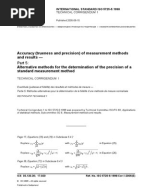
INTERNATIONAL STANDARD IS0 5725-4 First edition 1994-l 2-l 5 Accuracy (trueness and precision) of measurement methods and results - Part 4: Basic methods for the determination of the trueness of a standard measurement method Exactitude (justesse et fid6W des r&u/tats et m&hodes de mesure - Partie 4: Mkthodes.
NOTE 1 Modifications to this basic method for particular purposes are given in other parts of IS0 5725. Annex B provides practical examples of estimating the precision of measurement methods by experiment. This part of IS0 5725 is concerned exclusively with measurement methods which yield measurements on a continuous scale and give a single value as the test result, although this single value may be the outcome of a calculation from a set of observations. It assumes that in the design and performance of the precision experiment, all the principles as laid down in IS0 5725-1 have been observed. The basic method uses the same number of test results in each laboratory, with each laboratory analysing the same levels of test sample; i.e. A balanced uniform-level experiment. The basic method applies to procedures that have been standardized and are in regular use in a number of laboratories.
NOTE 2 Worked examples are given to demonstrate balanced uniform sets of test results, although in one example a variable number of replicates per cell were reported (unbalanced design) and in another some data were missing. This is because an experiment designed to be balanced can turn out to be unbalanced. Stragglers and outliers are also considered. The statistical model of clause 5 of IS0 5725-1:1994 is accepted as a suitable basis for the interpretation and analysis of the test results, the distribution of which is approximately normal. The basic method, as described in this part of IS0 5725, will (usually) estimate the precision of a measurement method: a) when it is required to determine the repeatability and reproducibility standard deviations as defined in IS0 5725-1; b) when the materials to be used are homogeneous, or when the effects of heterogeneity can be included in the precision values; and c) when the use of a balanced uniform-level layout is acceptable. The same approach can be used to make a preliminary estimate of precision for measurement methods which have not reached standardization or are not in routine use.
Organization: International Organization for Standardization Document Number: iso 5725-2 Publish Date: 1994-01-01 Page Count: 50 Change Type: COR1 Available Languages: EN DOD Adopted: NO ANSI Approved: NO Most Recent Revision: YES Current Version: YES Status: Active. Iomega Screenplay Codec. IHS Standards Expert subscription, simplifies and expedites the process for finding and managing standards by giving you access to standards from over 370 standards developing organizations (SDOs). FEATURES & BENEFITS • Maximize product development and R&D with direct access to over 1.6 million standards • Discover new markets: Identify unmet needs and discover next-generation technologies • Improve quality by leveraging consistent standards to meet customer and market requirements • Minimize risk: Mitigate liability and better understand compliance regulations • Boost efficiency: Speed up research, capture and reuse expertise For additional product information, visit the page. HOW TO SUBSCRIBE.